Galaxy Award
Introduction
The Galaxy Award is the most prestigious accolade in Chinese science fiction, recognizing outstanding works and authors in the genre. Established in 1986, it is often considered equivalent to international awards like the Hugo and Nebula. The award is a significant marker of achievement in the burgeoning field of Chinese science fiction, highlighting both established and emerging talents.
History and Significance
The Galaxy Award was created to promote science fiction writing in China, a nation with a growing interest in the genre. It serves to acknowledge the creativity and contributions of writers who explore imaginative and speculative narratives. Over the years, the award has played a crucial role in nurturing a unique Chinese voice within the global science fiction community, reflecting the country's cultural and technological advancements.
Categories and Criteria
The Galaxy Award encompasses various categories, including Best Novel, Best Short Story, and Best Newcomer, among others. Winners are selected based on their ability to captivate audiences with imaginative and thought-provoking narratives, often incorporating themes of technology, futurism, and humanity's place in the universe. The award ceremony is a celebrated event in the sci-fi literary calendar, often featuring discussions and presentations by leading authors and critics.
Notable Winners
Prominent figures in Chinese sci-fi, such as Liu Cixin and Wang Jinkang, have been recipients of the Galaxy Award. Liu Cixin, renowned for his "The Three-Body Problem" series, has achieved international acclaim, significantly raising the profile of Chinese science fiction on the world stage. Wang Jinkang's "Sowing on Mercury," a novella that explores themes of evolution and existentialism, is another work that has been honored by the Galaxy Award.
Contemporary Developments
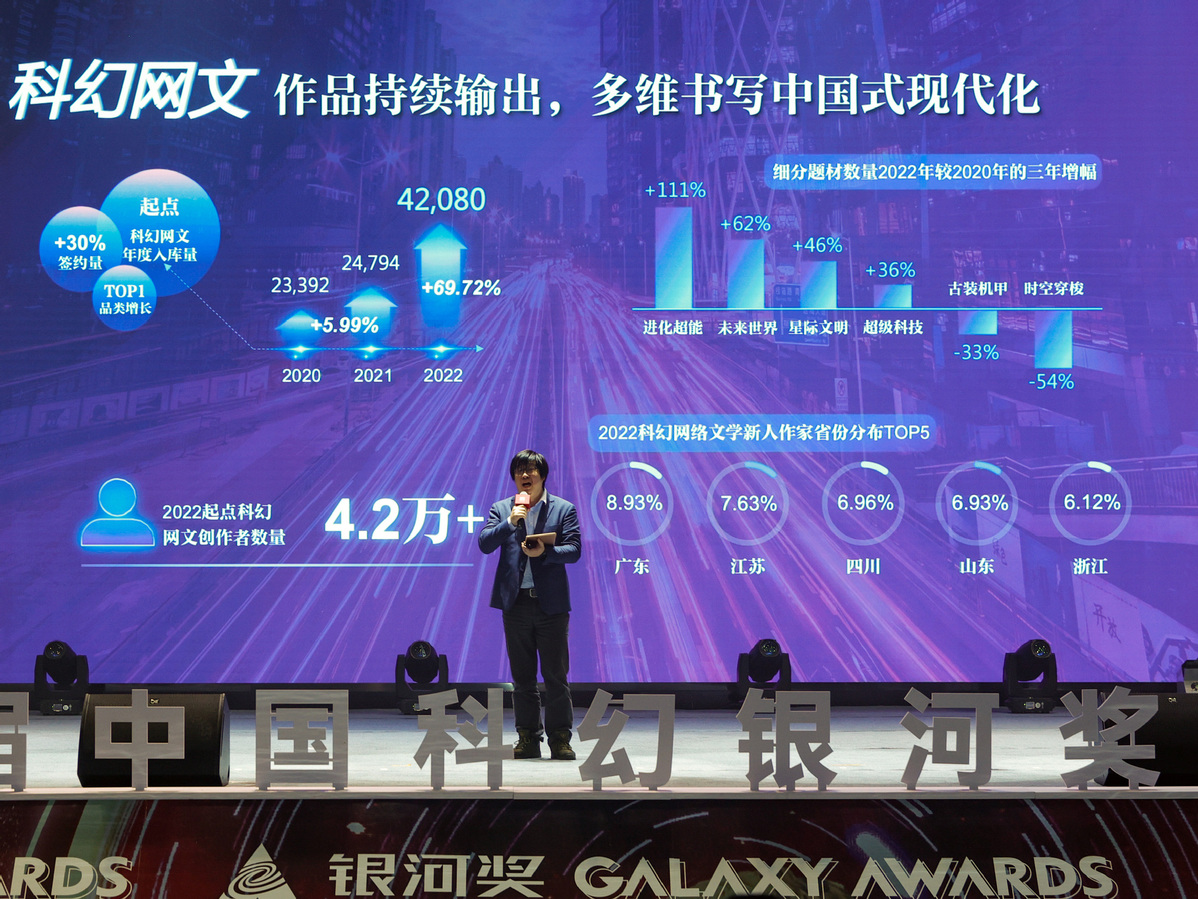
In recent years, the Galaxy Award has reflected the evolving landscape of Chinese science fiction. As noted in a white paper presented at the 33rd Galaxy Awards ceremony, the genre has expanded to include diverse themes such as mecha, space farming, and time travel. This diversification is indicative of the broader trends in online sci-fi literature, where cross-genre storytelling is becoming increasingly popular among young authors like Tianrui Shuofu, whose works blend high technology with ancient martial arts.
Impact on Chinese Science Fiction
The Galaxy Award has been instrumental in shaping the contemporary science fiction scene in China. It has encouraged writers to push creative boundaries and explore complex narratives that resonate with both domestic and international audiences. The award not only celebrates individual achievements but also contributes to the cultural dialogue surrounding science fiction as a literary form.
Future Prospects
As Chinese science fiction continues to gain global attention, the Galaxy Award is expected to play an even more significant role in promoting innovative works. With China's rapid technological advancements and its position as a global economic powerhouse, the themes explored in Chinese sci-fi are becoming increasingly relevant to international readers. The Galaxy Award will likely continue to be a beacon for new and exciting voices in the genre, fostering a vibrant and dynamic literary community.
The Galaxy Award remains a testament to the rich and evolving tradition of science fiction in China, celebrating stories that challenge, inspire, and entertain. Through its recognition of outstanding works, the award not only honors the achievements of individual authors but also contributes to the broader narrative of science fiction as a means of exploring and understanding the complexities of our world.








